


12.2025 Valencia – many steps forward and international appeal
As intermediaries, we at Thinking Circular® always stand between actors from science, politics, and business. It is our role to bring the actors together, to mediate, to translate. After an open debate, the actors from the various sectors can decide which next steps in the development of processes seem appropriate for them.
This was also the case in the accompanying process with the Polytechnic University of Valencia. The research collaboration entered its next phase with the help of the NATURGY Foundation. We would particularly like to thank Prof. Miguel Ángel Artacho Ramírez, Director of the PRINS Institute. The translation of the joint research work required a technically easy-to-read translation into Spanish, which was financed by NATURGY. The publication can be downloaded free of charge and the colloquium is available in full online.

v.l.v.r.: Luis Palomino, ASEGRE; Eveline Lemke; María Eugenia Coronado, Natury; Vicente Martínez Mus, Comunitat Valencia; Débora Domingo-Calabuig, UPV; Miguel Àngel Artacho Ramírez, UPV; Eugenio Cámara, EMTRE; Manel Calvo Díaz, Naturgy
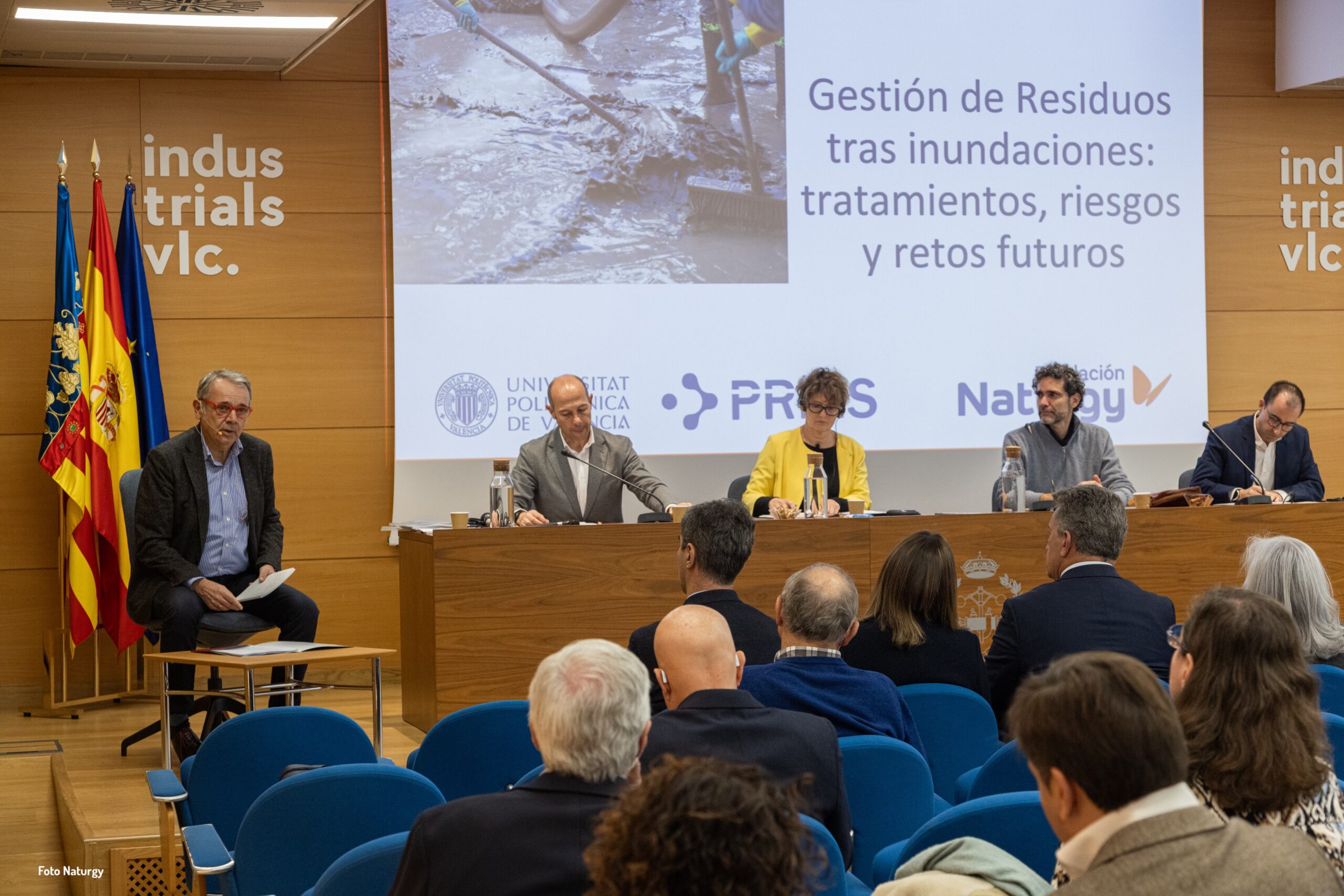
The colloquium held on December 11, 2025, in Valencia provided an opportunity to share important findings directly with Vicente Martínez Mus, Deputy Vice President and Head of Economic and Social Recovery in Valencia, as well as Infrastructure and Regional Planning. Direct dialogue in a trusting environment makes it much easier to arrive at findings that can also be implemented. Also present were Eugenio Cámara, Technical Director of EMTRE, and Luis Palomino, Secretary General of the Association of Hazardous Waste Disposal Companies in Spain, representing municipal waste disposal companies. They all want to use the insights gained for the next flood and incorporate them into all preparations and planning.
Since my last visit to Spain, many steps have been taken to implement the circular economy. Spain is also focusing on introducing the circular economy, and the starting point was more difficult than in Germany. However, this does not yet apply to issues of urban development, space for water, or water quality even after the 2024 floods; there is still plenty to discuss here. Visually, there is no longer any flood debris to be seen, roads and paths have been largely cleaned up, and access routes have been established. Waste disposal fees for all types of waste have also been introduced. Much of the debris and waste in Valencia has been processed and sent to approved landfills. Even though the waste is out of sight, it is still there, e.g., in temporary storage facilities that are not equipped as landfills. I was also able to address the importance of developing state-of-the-art landfills and that waste incineration is also an option for the safe destruction of hazardous waste. It is clear that these developments also need to be compared with the conclusions reached in Germany on the circular economy. Further research is to be carried out on this together.
International appeal as far as India:
We would also like to extend a special greeting to the moderator of the event, Jorge Alacid, who is also chief coordinator for all channels at Las Provincias. Together with his colleague Amalia Yusta, he released a documentary film after visiting the Ahr Valley in July 2024.
“The slow road to reconstruction: lessons from Germany” ( “El lento camino de la reconstrucción: lecciones desde Alemania”) won an award at the Mumbai Shorts International Film Festival and received a special mention as :
- Best Documentary
- Best Concept
Congratulations to the LAS PROVINCIAS team on this recognition!
Mumbai International Short Film Festival
The film with subtitles can also be viewed on YouTube.
 powered by